
In a Dutch criminal case, the court may only find a charge proven if it is convinced of guilt by the content of legal means of evidence (Article 338 of the Dutch Code of Criminal Procedure, Sv). Unlawfully obtained evidence is not automatically excluded: under Article 359a Sv the court can reduce the sentence, exclude the evidence or, in extreme cases, declare the prosecution inadmissible, and often it only notes the defect.
Which evidence may a Dutch court use?
Article 339 Sv lists five legal means of evidence, and the list is closed. They are the court’s own observation, statements by the defendant, statements by a witness, statements by an expert, and written documents.
A knife, a hard disk or a DNA profile is not evidence in itself. It reaches the court through one of the five categories, usually as an official police report (proces-verbaal) or an expert report. Within the closed list the court weighs the evidence freely: there is no fixed hierarchy, and live testimony does not automatically outrank a written statement.
Dutch law does not use the phrase “beyond reasonable doubt”. It requires that the court has become convinced that the defendant committed the offence, and the judgment must show which evidence supports which element of the charge.
What are the minimum evidence rules?
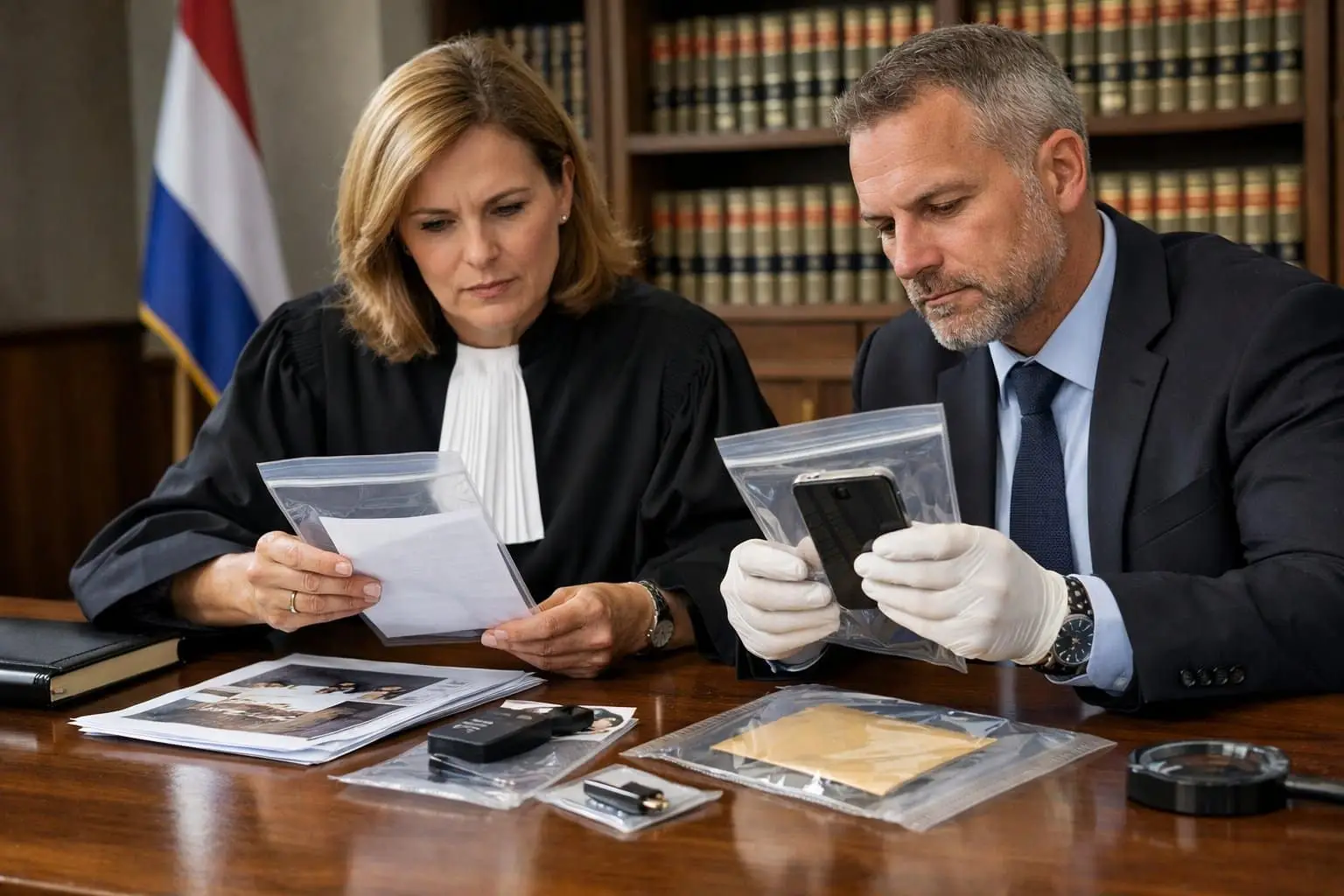
Two rules limit the court’s freedom. A conviction may not rest solely on the defendant’s own statements (Article 341(4) Sv), and not solely on the statement of one witness (Article 342(2) Sv).
Some support from another source is required, but it does not have to cover every detail. There is one important exception: an official report by an investigating officer can by itself prove the charge (Article 344(2) Sv). That is why the quality of the police report is often the real battleground in a Dutch criminal case.
Who authorises which investigative powers?
Every investigative power needs a legal basis in the Sv, and the more intrusive the measure, the higher the required authority. An investigating officer can stop and search, seize visible objects and take statements; the public prosecutor (officier van justitie) directs the investigation and orders more intrusive measures.
The investigating judge (rechter-commissaris) is required for the most intrusive measures, such as searching a home against the occupant’s will and intercepting communications. Many special powers are only available where pre-trial detention is allowed, which in principle means offences carrying a maximum prison sentence of four years or more, plus listed offences (Article 67(1) Sv). Every exercise of a power must be recorded in an official report, so that it can be reviewed afterwards.
අපගේ ලිපිය නෙදර්ලන්තයේ අපරාධ ක්රියා පටිපාටිය describes the full procedure, and our overview of a නෙදර්ලන්තයේ අපරාධ නඩුවක් follows a single prosecution.
What are the rules for digital evidence and phone searches?
Investigators can secure data during a search and demand stored data from providers. In serious cases, the public prosecutor can order covert access to a computer system with prior authorisation of the investigating judge (Article 126nba Sv), a power limited to offences for which pre-trial detention is allowed that seriously breach the legal order.
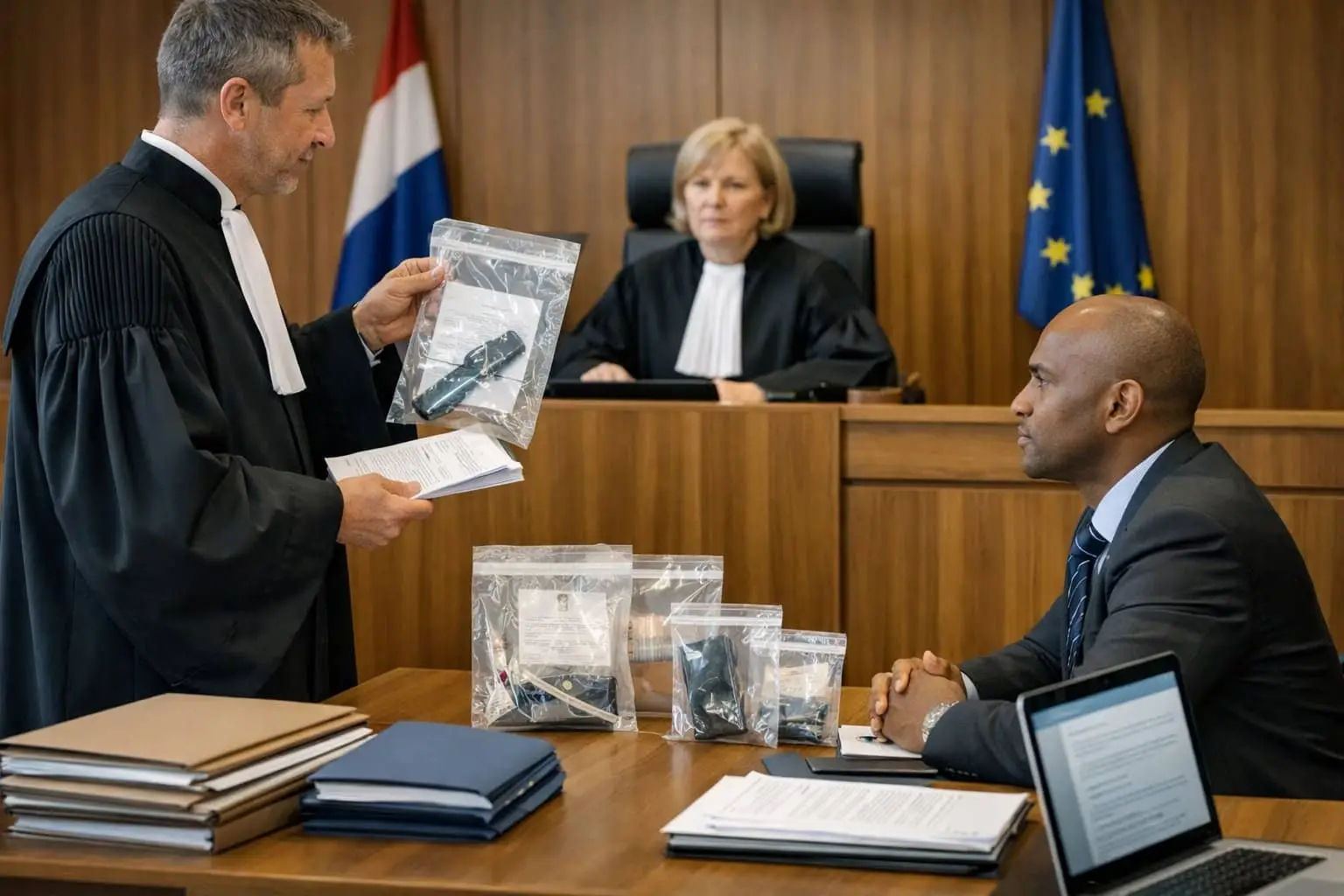
Searching a seized smartphone is not simply part of the seizure. According to Supreme Court (Hoge Raad) case law, a limited examination can be done by an investigating officer, but an examination that gives a more or less complete picture of someone’s private life requires authorisation by the public prosecutor or the investigating judge. With a modern smartphone, the more intrusive category is the norm, so the level of authorisation is one of the first things a defence lawyer checks.
Data from decrypted communication services shared between states has been accepted by Dutch courts, provided the defendant can test its reliability and the lawfulness of how it was obtained. Analysis tools used by the police are not means of evidence themselves; what reaches the court is the report of the officer or expert who used them, and its reliability is tested through expert examination. Police processing of personal data falls under the Police Data Act (Wet politiegegevens), not the GDPR. See also our article on නෙදර්ලන්තයේ පරිගණක අපරාධ සහ සයිබර් අපරාධ.
Can a case be decided on written statements and hearsay?
Yes. Since a 1926 Supreme Court ruling, a witness may testify about what someone else told them, and written documents are a legal means of evidence under Article 339 Sv. Many Dutch criminal cases are decided on the written file without witnesses appearing in court.
The counterweight is Article 6 of the European Convention on Human Rights (ECHR), which guarantees the right to examine witnesses against you. If a statement is used without the defence having been able to question its maker, the court asks whether there was a good reason for the absence, how decisive the statement is, and whether there were sufficient counterbalancing factors.
A request to hear witnesses is therefore one of the defence’s most important tools. It can be made to the investigating judge during the investigation (Article 182 Sv) or to the court before the trial. A request that is early, specific and explains why the witness matters for the court’s decision has a far better chance. See our article on the අපරාධ නඩු වල මූලික නඩු විභාගය.
What happens when evidence was obtained unlawfully?
Dutch law has no automatic exclusionary rule. If an irreparable procedural defect occurred during the preliminary investigation, Article 359a Sv allows the court to reduce the sentence, exclude the evidence obtained through the defect, or declare the prosecution inadmissible if a fair trial is no longer possible.
The court weighs three factors: the interest served by the breached rule, the seriousness of the defect and the harm it caused (Article 359a(2) Sv). It may also simply note the defect without consequence, which is the most common outcome. The defect must have occurred in the investigation into the offence charged, and the defendant can only rely on a rule meant to protect his own interests; an unlawful search of someone else’s home does not help him.
The Supreme Court reserves exclusion of evidence mainly for two situations: a breach of a Convention right of the defendant where exclusion is needed to secure a fair trial, and a very serious breach of a fundamental right where exclusion is needed to prevent repetition. A structural failure to comply with a rule can also justify exclusion. Evidence obtained through torture or inhuman treatment is always inadmissible under Article 3 ECHR.
Unreliable evidence is a separate issue. A statement obtained under improper pressure can be attacked both as a breach of the right not to incriminate yourself and as material on which no court can safely rely.
What can the defence do during the investigation?
The defence’s strongest tools are available before the trial starts. That is why it matters to involve a අපරාධ නීති before the first police interview.
- Consultation and assistance: an arrested suspect may consult a lawyer for up to half an hour before the first interview (Article 28c Sv), and may ask for the lawyer to attend and take part in the interview (Article 28d Sv).
- Case file: the defence can ask the public prosecutor to add specifically described documents to the file, for example the technical material behind a digital analysis (Article 34 Sv).
- Investigating judge: a suspect who has been interviewed can ask the investigating judge to carry out investigations, including hearing witnesses and appointing an expert (Article 182 Sv).
- At trial: the defence can put forward an expressly substantiated position, which the court must address in its judgment if it departs from it.
How is evidence from abroad treated?
Within the EU, the European Investigation Order allows a Dutch judicial authority to ask another member state to carry out an investigative measure. The Dutch court starts from mutual trust: it assumes the foreign authorities acted lawfully and does not fully review the foreign investigation.
That trust has limits. If the defence gives concrete indications that fundamental rights were breached abroad, the court must examine them, and it remains responsible for the fairness of the trial as a whole under Article 6 ECHR. The EU e-Evidence Regulation (EU) 2023/1543, applicable from 18 August 2026, allows judicial authorities to send production and preservation orders for electronic data directly to service providers in another member state. Our article on නෙදර්ලන්තයේ දේශසීමා හරහා අපරාධ ආරක්ෂාව covers the defence side.
Does the new Code of Criminal Procedure already apply?
No. A fully revised Code of Criminal Procedure has been adopted, but it enters into force at a later date set by royal decree; the planning points to 2029, and no firm date has been fixed.
Until then, the current Sv and its article numbers apply in judgments, indictments and defence submissions. Commentary that describes the new Code as the law in force is premature. When it takes effect, check which regime applies to acts carried out before and after that date.
What can we do for you in a criminal investigation?
අපගේ අපරාධ නීතිය team assists suspects and defendants from the first police interview onwards.
- We prepare you for the police interview and attend it under Article 28d Sv.
- We check whether each investigative power was exercised with the required authorisation.
- We request documents to be added to the case file under Article 34 Sv, including technical material behind digital analyses.
- We ask the investigating judge to hear witnesses or appoint an expert under Article 182 Sv.
- We argue procedural defects and the consequences under Article 359a Sv at trial.
සාරාංශය
- The court may only use the five legal means of evidence in Article 339 Sv and must be convinced of guilt (Article 338 Sv).
- A conviction cannot rest solely on the defendant’s statement or on one witness, but an officer’s official report can suffice (Articles 341, 342 and 344 Sv).
- Intrusive powers, such as an extensive phone search, require authorisation by the public prosecutor or the investigating judge.
- Unlawfully obtained evidence is not automatically excluded; Article 359a Sv offers sentence reduction, exclusion or inadmissibility.
- The new Code of Criminal Procedure is not yet in force; the current Sv applies.
නිතර අසන ප්රශ්න
Is illegally obtained evidence automatically excluded in the Netherlands?
No. Under Article 359a Sv the court can reduce the sentence, exclude the evidence or declare the prosecution inadmissible, weighing the interest of the breached rule, the seriousness of the defect and the harm caused. Often it only notes the defect.
Can I be convicted on a confession alone?
No. Article 341(4) Sv provides that the court cannot find the charge proven solely on the defendant statements. Some support from another source is required.
Can the police search my phone after seizing it?
A limited examination can be done by an investigating officer. An examination that gives a more or less complete picture of your private life requires authorisation by the public prosecutor or the investigating judge.
Can I ask for witnesses to be heard before the trial?
Yes. A suspect who has been interviewed can ask the investigating judge to carry out investigations, including hearing witnesses (Article 182 Sv). Make the request early and explain specifically why the witness matters.